Natural Gas Tankless Water Heaters - Suggestions?


We upgraded two years ago from a old-fashioned Sears 40 gallon tank water heater to a Takagi T-H3-DV-N tankless water heater. We purchased from supplyhouse.com, around $1100 shipped. There's a 5 year warranty on this unit. PSE&G offers a $300 rebate. There may also be a federal rebate (but we maxed that out). While these units are more efficient (since they don't keep 40 gallons of water at temperature all the time, and their combustion is very efficient), they have higher install costs, so there's little savings. It's mostly comfort and convenience that they bring. Ok, and they are cool technology  .
.
Tankless water heaters are a little different than tank-type. Since there's no giant tank of water, there's no hot water ready-to-go (which helps with their efficiency), which means you may have 30 seconds of cool water when showering. But, and I think that's the main benefit, you will never run out of hot water again, even if you fill a large tub, or a hot tub, or have two teenagers in the house (as we do). Another benefit: these units are compact, and wall mounted, so the floor space in your basement taken up by the old water heater will free up. Most regular old-fashioned water heaters usually fail when the tank jacket cracks or corrodes over time, which causes a leak and then a flooded basement. Since there is not tank in these units to begin with, and the internals are all 316 alloy stainless steel, those kind of water leak risks are gone.
Be prepared to have to install a bigger gas line from the meter to the heater, since these have a much higher peak BTU in order to keep up with the heating demands. You'll also need a nearby power socket, which you may not have. They are direct vent (since the exhaust gases are so cool), which means some reconfiguration of the exhaust may be needed (in our case direct vent with PVC through a basement side wall). Lastly, these units (due to their efficiency) also have a condensation drain (due to the cool combustion gases), which means you either need a nearby sink/drain, or a condensate pump.
Tankless water heaters are "new" in the U.S, so plumbers may try to scare you as they are often relatively unfamiliar with these themselves, but I think those fears are overblown. Reliability is not an issue, it's decades-old proven technology. Plumbers will probably charge a bit more if you're converting (since there's a bit more labor like the vent), but some may "pad" because of their unfamiliarity, so shop around a little bit.
Our unit has been completely problem free for the 2 years we had it. The only maintenance is bi-annual flush with regular vinegar, a bucket, and a circulating pump (to prevent scale build up). We have a whole-house water softener, so that may be overkill, but better safe than sorry.
Feel free to contact me if you'd like to know more specifics. We would definitely go this route again. And yes, I am European

I don't know much about the technology (although Evan covered it nicely) but I ca tell you this: a friend who is a plumber installed one in his own house and speaks highly of it.

I have had a Rheem for 5 years that I love. Mine uses stainless steel double wall pipe to vent, which is not cheap, but the unit has been problem free. I, too, use a whole house softener and I have never done the vinegar rinse.

I have a Rennai and a water softener. It can take at least a full minute to get hot eater when it has not been used for a while but it is true that once it starts, you do not run out escept maybe for a few seconds. It is relatively hard to find people who know how to service a Rennai where I live (not in Maplewood anymore) but there are some. I do not flush it myself but have had it done every other year or so by a plumber who purports to know the system. So far so good. Operating costs probably low but grouped in my heating and gas dryer cost, so i don't know the exact cost. To me, the key benefit is the ability to do laundry while someone is showering, and so on.

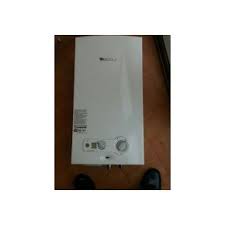
I am always puzzled by the unit and installation costs associated with these units here in the states. And never mind finding someone who is comfortable and willing to do it. I am from Spain. My grandmother has a tank-less water heater which is located in the kitchen, by the sink, behind a kitchen cabinet. She lives in the bunnies so she still uses propane tanks (a bit bigger than those used for grilling) to power it. It is considered a kitchen appliance, much like a fridge or a dishwasher, and heats water for the entire house. No pressure issues, no flushing (but she probably does not have hard water as we do here either) and it never runs out of water, unless the tank is empty. The unit is about $300 bucks to purchase and little to install. It is technology that has been around for many decades. This is a picture of this "appliance".
Robert_Casotto said:
who's the leading maker of these?
https://www.cointra.es/categoria-de-producto/calentador-gas/

I like to post my shpiel on tankless water heaters. This was published a few years ago and it still applies.
Tankless water heaters
Published: June 11, 2014 - by John Cataneo
Categories: Water Heaters
Paloma, Bosch, Rinnai, Takagi...there are lots of tankless, or instantaneous, water heaters out there these days. They do a great job and lots of homes in Europe use them.
Here in America, though, they present some problems.
The carbon monoxide-filled exhaust is expelled by a fan out its flue pipe which, by most building codes and depending on the unit, must terminate anywhere from one to ten feet away from any building opening such as a door or window. That means drilling a 3" hole in the side of your home.
The units themselves use a lot of gas all at once. A typical whole-house unit burns around 200,000 BTUs per hour. Compared to your 50-gallon gas-fired, tank-type water heater, which burns around 50,000 BTUs per hour, that’s a lot of fuel.
What that means is a tankless water heater requires a much larger gas pipe, and meter, than your tank type may be using. And because it burns so much more fuel, it also needs a lot more fresh air for combustion. This adds to their considerable installation cost as very often a large dedicated gas pipe from the meter to the unit is required and a fresh air duct will have to come from outside. That's another 3" hole in the side of the house.
If your lifestyle is such that you’re frequently using hot water throughout the day, keep in mind that your tankless heater will be on, probably burning 200,000 BTUs per hour for all of that time. The tank-type will chug along slowly burning its 50,000 BTUs a few times per day and store the water for when you need it.
Their high efficiency ratings stem from the fact that the unit does not run to simply maintain a constant temperature the way a tank type unit does. They are not inherently “efficient” in the way you may want to think they are. To understand this better, you need to know the difference between combustion efficiency (how much of the burning fuel directly translates into available hot water during actual usage) and seasonal efficiency (an estimate comparing fuel usage to hot water usage over an assumed variety of conditions over time).
Most of what we hear about a tankless water heater’s high efficiency has to do with its “seasonal” ratings and is best realized when installed for someone who doesn’t turn on their hot water very often for long periods of time. If the heater sits there dormant all day long not turning on until someone comes home from work, does some dishes and takes a shower, that would the perfect application, and real fuel savings might be gained.
Looking at practical usage, they claim to give 6 gallons or more per minute of endless hot water but if you look at the literature included with most any common unit, they sort of redefine “hot water”.
Consider these numbers:
90° F rise / 3.2 gpm
77° F rise / 3.7 gpm
65° F rise / 4.5 gpm
55° F rise / 5.2 gpm
45° F rise / 6.4 gpm
Rise is the amount the water temperature will be raised from the inlet of the heater to the outlet of the heater. That means that a 6.4-gallon unit will give you an endless supply of water raised 45 degrees from the temperature being supplied to the unit at a rate of 6.4 gallons per minute.
So, during the winter months in our part of the country when the temperature of our incoming water hovers around 40 degrees, you can expect 6.4 gallons per minute of 85-degree water.
That’s not hot at all.
Your showerhead might only pass 4.5 gallons per minute so, in this unit, we can expect a (check the chart) 65-degree rise. That will give us 110-degree water. That’s much better but there’s nothing left for another fixture to run simultaneously.
Of course, in the warmer months this is less of an issue but it’s not something to ignore.
This is a speech I’m well prepared to give as I get calls and emails for these units all the time. I am very happy to install them in a person’s home but always with this large disclaimer:
They simply don’t provide hot water the way we Americans are used to having it.
After a newly installed unit goes in I sometimes still get the call: “It’s not working!”
But it is working. Just turning on a faucet may not be enough to turn the unit on. They are activated by an internal device called a flow switch that senses water flow through the system (you turned on a faucet) and then turns on the exhaust fan, an ignitor, then the flame, then you start to get hot water. That flow switch needs to sense a minimum amount of moving water, usually 0.6 gallons, to get the process started. A trickle of water to wash your kid’s hands or to wet a facecloth may not be enough to activate the unit and that process may seem like an eternity to some when standing at the sink. You may need to turn the faucet on for stronger flow to get hot water. Is that a waste of water? Probably. At least sometimes.
Many professionals in the plumbing, heating and HVAC industry are now finding that a combination of tankless and tank water heaters work best to buffer the erratic behaviors of the tankless alone. When installation costs keep climbing, you can't look for payback anytime soon.
As a professional plumber and owner of Gateway Plumbing and Heating, licensed by the Department of Buildings, and a person dedicated to understanding and embracing new technology in my field, I can say that I like tankless water heaters.
What I don’t like is how they’ve been presented to the public, showcased on DIY television shows and sold in large retail home centers with such an abundance of misleading, purely positive information. They are very sophisticated, fuel-burning appliances that require some thought before they are selected, bought, installed or repaired and just like all mechanical equipment, are simply not suitable for every home and every person.
You are right to ask questions before diving in.
Perhaps a good first step in the right direction is to question using the terms “efficient” and “endless shower” in the same conversation.
John Cataneo, LMP
www.GatewayPlumbing.com

Sponsored Business


Promote your business here - Businesses get highlighted throughout the site and you can add a deal.
Rentals
Advertisement


I see some old posts into 2013 but nothing recent. Anyone have thoughts about installing a Natural gas tankless water heater. Are they a pain generally. The Europeans seem to love them, right?
I would guess us Americans would stick with tank water heaters as that is easy and the norm.
Are there good thoughts out there?