Source for replacement tongue-and-groove floor boards? archived

Dec 31, 2014 at 10:11am

I had some patchwork done (feathered in) when a portion of the oak flooring in my LR needed to be cut out due to a leaky pipe. There's another thread on MOL about wood floor refinishing. I used Jacob's son, Bruce, and I'd highly recommend them.
http://www.professionalfloorrefinishing.com/
http://www.professionalfloorrefinishing.com/

Dec 31, 2014 at 11:23am Edited
If you are judging the lack of sub flooring by looking up between the joists in your basement I believe that you may be looking at the old sub flooring which was also tongue and groove of a lesser quality (built in pre plywood days). Most of the old sub-flooring is 5" pine with grooves cut down the middle. Look to see if the knots are the same from below as above. I'm guessing not.
If there was no sub flooring the floor would be pulling apart everywhere, oak or not. I would be very interested if I am wrong.
Is it possible that the sub flooring has cracked in those few trouble spots thus allowing the oak above to pull apart?
Either way it is a job which requires the right tools and a little finesse.
If there was no sub flooring the floor would be pulling apart everywhere, oak or not. I would be very interested if I am wrong.
Is it possible that the sub flooring has cracked in those few trouble spots thus allowing the oak above to pull apart?
Either way it is a job which requires the right tools and a little finesse.
Yeah, but most of that type of sub floor was ran on a 45 degree angle. Buddy just bought a house with the same situation, no sub floor on first floor and the architect didnt realize the 2nd fl joists changed direction till after the gut. 1st fl flooring is tight as a drum btw.
Indeed, I have seen old sub flooring at a 45 degree angle and also run perpendicular to the joists as it is in my 1929 year old house. I'm amazed that any flooring, even oak would not have MANY separation and bowing problems without it, especially over an 85 year period. Interesting. Wow.


we have one layer of 1" white pine floor boards, 3" wide throughout our 1907 home. No second layer until we updated and refloored the whole first floor. It was common place construction practice. Over time the pine we have has shrunk, leaving gaps, but the t&g is wide enough to compensate. No cupping or bowing.
The problem we had was running the new floor in the same direction as the previous without cutting all of the trim work to make room for plywood sub.
The problem we had was running the new floor in the same direction as the previous without cutting all of the trim work to make room for plywood sub.
2-1/2" flooring without a subfloor from that period is probably yellow pine. Can you post a pic?

Ours is yellow pine with no subfloor. I pulled material for repairs out of the attic floor in closets.
steel said:
Indeed, I have seen old sub flooring at a 45 degree angle and also run perpendicular to the joists as it is in my 1929 year old house. I'm amazed that any flooring, even oak would not have MANY separation and bowing problems without it, especially over an 85 year period. Interesting. Wow.
I know my way around framing and woodwork (I worked for a contractor while I was in college). Believe me - it's just the flooring directly on the joists. You can actually look right down into the basement in a few places where the joints have degraded.
And I definitely understand the complexities of trying to fit a couple of boards into the middle of a tongue-and-groove layout. But right now I'd like to see if I can at least get compatible replacement boards to start with. I have the option of "borrowing" from a closet or behind the couch, but that just moves the problem.
Thanks all.
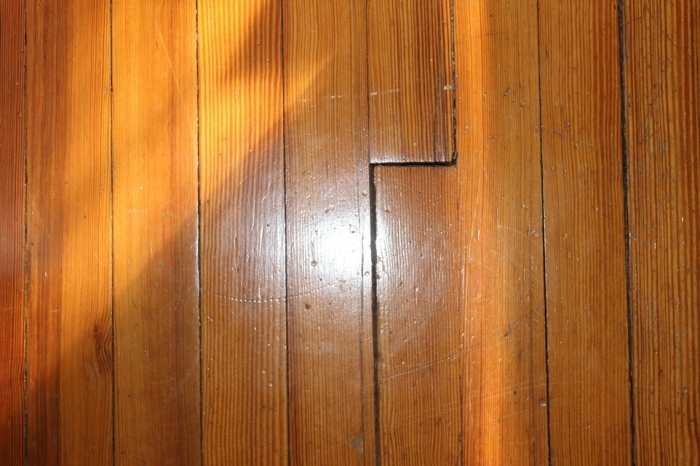
Here's a picture of the floor. Any help on the wood species appreciated.


if you only need some small limited pieces it can sometimes be stolen from the back of closets where something that doesn't match could be put in it's place.
Jan 1, 2015 at 8:33am Edited
Definitely yellow pine...long leaf yellow pine (aka heart pine or Carolina pine) in vertical or comb grade. These came in long lengths (up to 16'+) and were typically nailed directly across the joists without a subfloor. Both partition and load-bearing walls were built on top of this flooring. Keep that in mind if you're thinking about replacing the floor.
As for repair, cutting the replacement boards in will be the easy part. Getting those replacements will be more difficult. It's pricey stuff, ~$20/sq. ft. if you buy from a dealer selling reclaimed or salvage. I got samples from these two places several years ago and both were perfect matches for grain and color:
Longleaf Lumber:
http://www.longleaflumber.com/reclaimed-heart-pine/1-clear-quartersawn/
Goodwin Company:
http://heartpine.com/heart-pine/antique-vertical/
I'd go with taking some from an out of the way place if possible or check with some local contractors that may have some from previous jobs. For a small repair, or to fill in where you moved some from, you can probably find select fir that is a decent match for grain, but the color may be a bit off.
As for repair, cutting the replacement boards in will be the easy part. Getting those replacements will be more difficult. It's pricey stuff, ~$20/sq. ft. if you buy from a dealer selling reclaimed or salvage. I got samples from these two places several years ago and both were perfect matches for grain and color:
Longleaf Lumber:
http://www.longleaflumber.com/reclaimed-heart-pine/1-clear-quartersawn/
Goodwin Company:
http://heartpine.com/heart-pine/antique-vertical/
I'd go with taking some from an out of the way place if possible or check with some local contractors that may have some from previous jobs. For a small repair, or to fill in where you moved some from, you can probably find select fir that is a decent match for grain, but the color may be a bit off.
Heart pine is very pretty wood. In our 1916 house the upstairs floors were heart pine, as was the sun room. I love the color.
If you don't need a lot for your repairs steal it out of closets and then just use regular wood or even carpet.
Unless you are very skilled and have a heavy duty planer use a hardwood floor specialist for the work. Cutting to the proper size and planing to the proper thickness requires skill and experience.
Good luck.
If you don't need a lot for your repairs steal it out of closets and then just use regular wood or even carpet.
Unless you are very skilled and have a heavy duty planer use a hardwood floor specialist for the work. Cutting to the proper size and planing to the proper thickness requires skill and experience.
Good luck.

You can not reply as this discussion is Closed!
For Sale

Free Items
Sponsored Business



Promote your business here - Businesses get highlighted throughout the site and you can add a deal.
Advertisement




More background: We have a 1925 dutch colonial - a very typical Maplewood style. The floors are 2.5 inch strip tongue and groove (some variety of oak I believe) directly over the floor joists on our first floor. No subfloor. A few of the boards are badly damaged, especially those where the ends were in the middle of a bay between joists. I'm actually surpised they were installed with no subfloor, as it puts a lot of load on the tonge in this situation.
We're probably looking at completely replacing the floors at some point, but in the interim, I'm looking for replacing/repairing a few of the worst boards. I'll have to get creative with the replacements, as there's no easy way to replace individual boards near the middle of the room.
Alternatively, is there a flooring guy who specializes in this sort of patching?