Restoring a wood salad bowl archived

Jul 26, 2011 at 6:22pm
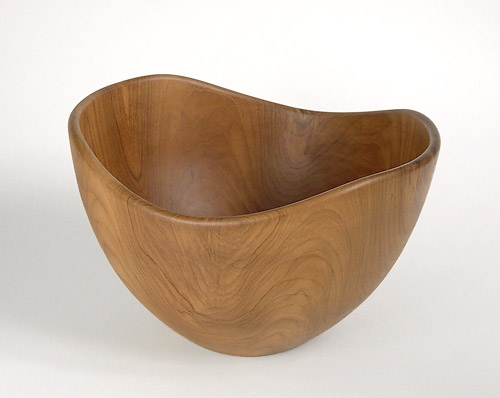

Actually, this "vintage" bowl looks more like the one I got in terms of the condition, and mine looks to be made of the same wood, which is teak:
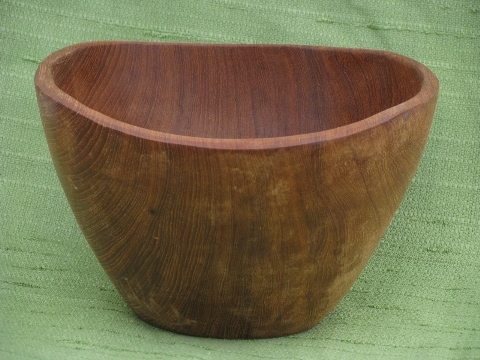

my guess is that the thing was oiled with vegetable oil, which will do exactly what you say -- its gets gummy & yucky.
DON't use abrasives -- you'll ruin it!
here's what I found when I googled --
http://www.hollandbowlmill.com/faq.htm
Do not use vegetable oil to protect your wooden bowls or other wood products! Vegetable oils will build up over time leaving the wood tacky and sometimes rancid. See the following question for help on how to remove vegetable oil buildup.
Can a wooden bowl that has an unpleasant build up and/or a rancid smell be saved?
Yes, a wood bowl can be revived by using a non-abrasive scrub pad, lemon juice, and pumice dust to remove the oil build up that has probably occurred over many years of use. This build up is likely caused by the use of a vegetable based oil or lard to preserve the bowl. Unfortunately using vegetable oil creates a breeding ground for bacteria, which then builds up and becomes gummy or tacky to the touch. In most cases using the pumice and lemon juice will safely remove the old layers of vegetable oil and the smell. It will probably take more than one application of lemon juice and pumice to do the job. Once the old oil layers are removed, clean the bowl with warm water and a mild soap and hand dry. When the bowl is completely clean and dry apply a coat of B's Oil Salad Bowl & Wood Preserver to properly preserve your bowl.
DON't use abrasives -- you'll ruin it!
here's what I found when I googled --
http://www.hollandbowlmill.com/faq.htm
Do not use vegetable oil to protect your wooden bowls or other wood products! Vegetable oils will build up over time leaving the wood tacky and sometimes rancid. See the following question for help on how to remove vegetable oil buildup.
Can a wooden bowl that has an unpleasant build up and/or a rancid smell be saved?
Yes, a wood bowl can be revived by using a non-abrasive scrub pad, lemon juice, and pumice dust to remove the oil build up that has probably occurred over many years of use. This build up is likely caused by the use of a vegetable based oil or lard to preserve the bowl. Unfortunately using vegetable oil creates a breeding ground for bacteria, which then builds up and becomes gummy or tacky to the touch. In most cases using the pumice and lemon juice will safely remove the old layers of vegetable oil and the smell. It will probably take more than one application of lemon juice and pumice to do the job. Once the old oil layers are removed, clean the bowl with warm water and a mild soap and hand dry. When the bowl is completely clean and dry apply a coat of B's Oil Salad Bowl & Wood Preserver to properly preserve your bowl.
Thanks, pete! I actually have a tub of their beeswax based wood bowl preserver. I'll try the lemon juice and pumice method and report back, though I'm not sure how to make pumice dust out of a piece of pumice short of whacking it with a hammer.

Simon Pearce maker of expensive custom wood bowls recommends rubbing with mineral oil...so once you get the old gunk off try that.


Thanks for starting this thread, and look forward to hearing about the results. I have the same old abused salad bowl, bought by my mother in the 1960s. Where can we buy pumice and B's Oil Salad Bowl preserver? (fishy?).

Concur with Online ID that mineral oil is fine too. Find it at pharmacy, if not grocery store first aid section.
nan, I think I got the B's oil at Williams Sonoma years ago when I bought a huge wood bowl there. You could also order it online, though it's $9 before shipping, so not cheap. On the other hand, it does last a long time.
Mineral oil would certainly be cheaper, but I've got at least one other salad bowl oil product to use up before I need to buy any more of this stuff one way or the other.
As for pumice, I have a piece that I've used for footcare (nice mixing that into the salad bowl ; - } ), but I also wondered if I could use something like corn meal or even baking soda - something that's mildly abrasive but food-safe.
Anyway, I'll fiddle with it again tonight and report back.
Mineral oil would certainly be cheaper, but I've got at least one other salad bowl oil product to use up before I need to buy any more of this stuff one way or the other.
As for pumice, I have a piece that I've used for footcare (nice mixing that into the salad bowl ; - } ), but I also wondered if I could use something like corn meal or even baking soda - something that's mildly abrasive but food-safe.
Anyway, I'll fiddle with it again tonight and report back.
Ok, great. Let me know. At one time I had some of that oil to use for butcher block counters, but don't know where it would be now. Also have pumice foot stone too. Never occurred to me to use it on salad bowl. This will be exciting.

How about scrubbing with salt and vinegar, or scrubbing with salt using half a lemon?

Don't use regular mineral oil... there is a food-grade mineral oil you can buy in kitchen supply stores, Bed Bath & Beyond, etc. and that's the only oil you should use. It doesn't have to be a special brand, but it should say on it that it's food grade or food safe.
We've talked to guys who make bowls and other wooden implements, and they agree that you can use a fine grade of sandpaper to keep the grain from becoming too raised after you wash a wooden implement, then oil it.
And FWIW, they said pumice DUST, not a pumice stone. I'd google that and see what you can find.
We've talked to guys who make bowls and other wooden implements, and they agree that you can use a fine grade of sandpaper to keep the grain from becoming too raised after you wash a wooden implement, then oil it.
And FWIW, they said pumice DUST, not a pumice stone. I'd google that and see what you can find.
j_r said:
How about scrubbing with salt and vinegar, or scrubbing with salt using half a lemon?
I might try this; it sounds fairly safe.

Pumice dust -- you can get that from stone specialists (its used for polishing marble, getting out stains, etc.). Not sure around here though, maybe the granite place across from Home Depot?

If you can wait a while there's a wood turning club that meets at the Essex Cty Environmental Center. I think they're called NJ Wood Turners. They would have a great deal of info since they are hobbyists who make thewse things.
Apollo T.
Apollo T.
j_r said:
How about scrubbing with salt and vinegar, or scrubbing with salt using half a lemon?
j r, great minds think alike. When I was standing in my kitchen this evening trying to decide what to use as my "abrasive" other than pumice dust - not a readily available commodity without smashing up my pumice stones - I looked in my cupboard and thought "salt"! And so I juiced half a lemon, then cut the lemon half in half again, and used that squeezed out lemon rind to rub the salt around the bowl.
After it seemed improved, I rinsed it out and dried it, but it still felt somewhat tacky, though no longer gummy. I did another round with the lemon and salt, and then remembered that I actually have a pumice soap bar from a long-ago trip to New Zealand that I use after working in the garden, so I rubbed that around the interior of the bowl and then rinsed it again. It wasn't perfectly smooth like fresh raw wood, but significantly improved.
I let the bowl dry, then applied a good coating of the B's Oil, let it sit for about 15 minutes, and then wiped it dry. While I wouldn't say the bowl is as good as new, it looks and feels much better and is ready to be used and enjoyed.
And thanks, Peggy and Apollo, for the additional input. I think my bowl is good enough for now.
Of course, the real challenge is finding a place to put it. But who could pass up such a pretty bowl for $2?
You can not reply as this discussion is Closed!





Any suggestions on what I can use/do to clean the bowl short of getting someone to put it back on a lathe and sand it that way? Maybe I need to use a coarser sandpaper?
The bowl looks something like this, so my round power sander is a little too big to fit inside: