low basement ceiling, how to finish? archived

Mar 28, 2013 at 5:38am

We had ours refinished. Drywall was used and access panels were installed for easy access to electrical, pipes and drains. We did replace all the pipes at the same time though, so leaks would not be an issue.

Mar 28, 2013 at 6:31am Edited
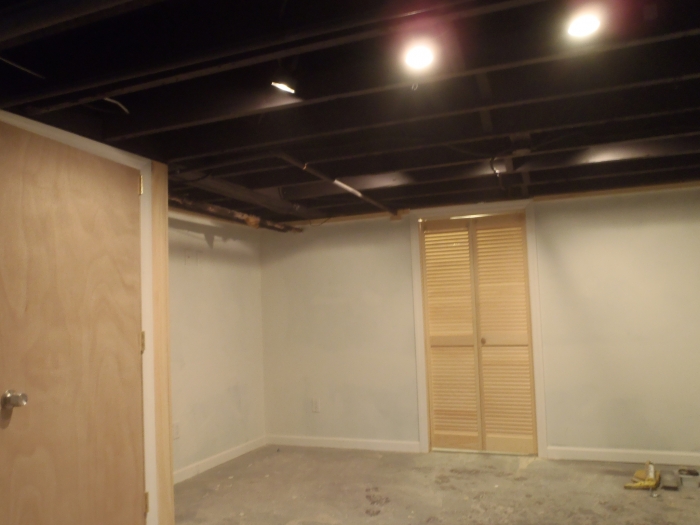
I recently saw a basement that was nicely finished I couldn't believe the simplicity of the concept. They had simply painted everything black---the pipes, ducts and wires. Everything receded visually. You have to use special paint, but it is less expensive than installing a drop ceiling and it preserves your headroom. I am sure you could use any color, but the black achieved the visual goal of making all the unsightly stuff seemingly disappear.

I was thinking about the same thing Calli mentioned until I saw that you were getting dust and debris from people walking on the floor above. Our finished basement used the technique Pmartinezv mentions, but it's a real pain because the panels are not all in the spots where we have had trouble over the years. If we had done the finishing of the basement ourselves (it was the previous homeowners that did this) I hope we would have created a system that would have provided better access.
Peggy,
I believe that priming and sealing the wood was part of the process---it wasn't just slapping up a coat of paint and being good to go.
I believe that priming and sealing the wood was part of the process---it wasn't just slapping up a coat of paint and being good to go.


If the joists are clean can't you just sheetrock the ceiling? You will lose about 1/2" of headroom. If it is truly unfinished you don't even need to tape and mud it. The sheetrock will stop the dust.

Our finished basement pipes are exposed and painted black. They have a cool, industrial chic look to them and it works, especially since that room is not only the playroom for the kids, but also the escape room for the adults when the kids have taken over the entire first floor.

Mar 28, 2013 at 7:48am Edited
I'd sheetrock not drop ceiling. Former looks better, no? Like the idea of painted pipes. High-hats between joists.
calliope said:
Peggy,
I believe that priming and sealing the wood was part of the process---it wasn't just slapping up a coat of paint and being good to go.
Of course, but eventually the cracks that exist now will most likely re-open. That's my experience even with priming and so forth.
FilmCarp said:
If the joists are clean can't you just sheetrock the ceiling? You will lose about 1/2" of headroom. If it is truly unfinished you don't even need to tape and mud it. The sheetrock will stop the dust.
This is an interesting idea. And caulk around any edges of the sheetrock before painting, of course.
Mar 28, 2013 at 11:20am Edited
Best way to go is a drop ceiling for future access to electrical and plumbing projects. If you use drywall you will need to put access panels anywhere there are electrical boxes,plumbing valves,etc.
Yes but remember the OP said it was a low ceiling. Make 6'8 into 6'6 and it will seem a lot worse.


https://www.facebook.com/media/set/?set=a.571465426213794.146344.116721515021523&type=1 ;-)
how about cutting sheetrock panels to fit inbetween the joists, and held up to the floor bottom with ledgers screwed on the sides of the joist, ABOVE the pipes and wires, painted black and dirt stopped????

locowolfy said:
how about cutting sheetrock panels to fit inbetween the joists, and held up to the floor bottom with ledgers screwed on the sides of the joist, ABOVE the pipes and wires, painted black and dirt stopped????
it would be a lot of work getting pieces up, around and between all the wires/pipes/conduit running through there, but i like your thinking

is dropped ceiling going to actually only take away 2" of headspace? i would have thought more. but yes, those 2 inches would make the headroom feel a lot tighter, unless by doing it in white it would make the basement "feel" brighter?
Dig crack up the contrete and then dig a little further and install a lower base for your floor. It should take 15 minutes.
More like 15 days, I'm thinking. That's a hell of a job, lowering the floor of a basement.
I like Locowolfy's idea a lot, although it is a bit labor-intensive.
There was an office space I worked in years ago that went "industrial chic." They painted everything white in the ceilings, tidied up wires in aluminum tubes, and left it. If, as Calli suggests, you can seal it sufficiently so that dust isn't coming through from above, it could work. There could be some kind of spray product that would seal it all in? Try Home Depot and see if the folks in the paint department have any suggestions.
I like Locowolfy's idea a lot, although it is a bit labor-intensive.
There was an office space I worked in years ago that went "industrial chic." They painted everything white in the ceilings, tidied up wires in aluminum tubes, and left it. If, as Calli suggests, you can seal it sufficiently so that dust isn't coming through from above, it could work. There could be some kind of spray product that would seal it all in? Try Home Depot and see if the folks in the paint department have any suggestions.
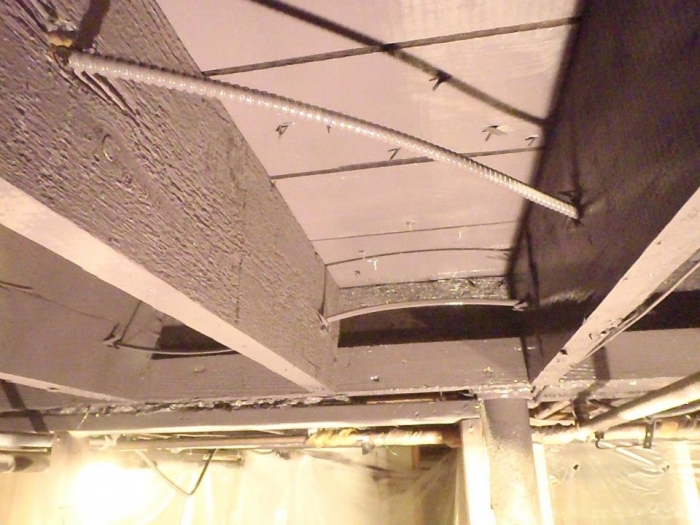
We sprayed this one, plan on using 3x the amount of paint to get proper coverage.
InfiniteSquirrel said:
Dig crack up the contrete and then dig a little further and install a lower base for your floor. It should take 15 minutes.
I researched this since our ceilings are about 6'4" and we have steam pipes at about 5'9" (yes many times). The big problem is foundation stability as dirt can shift from under the foundation towards the area that you are digging. If your foundation goes down far below the floor it could be possible but it is nothing that I would consider. Too scary for me.
ok- last question on this subject, which may actually solve my problem, or rather NOT. doing research i found that a minimum ceiling height has to be 7'-0" by code (it wasn't clear what state they were talking about in the post i read), not including the depth of the joists (I assume 7'-0" to the bottom of the ceiling/top of the joists). so by this method i would not be able to put a drop ceiling or any other ceiling under the joists.
can anyone concur?
can anyone concur?
You are dealing with existing conditions, not new construction. The only issue is how much you want to duck.
FilmCarp said:
You are dealing with existing conditions, not new construction. The only issue is how much you want to duck.
Unfortunately, this is probably true. I watch my taller friends in our basement with great trepidation, because there are quite a few opportunities for them to really clock themselves on the sheetrocked areas where the pipes run.
PeggyC said:
FilmCarp said:
You are dealing with existing conditions, not new construction. The only issue is how much you want to duck.
Unfortunately, this is probably true. I watch my taller friends in our basement with great trepidation, because there are quite a few opportunities for them to really clock themselves on the sheetrocked areas where the pipes run.
Hang something, like a ribbon, that goes about a foot down. They will see the ribbon and will make sure to look up before they hit their heads.
That would be a LOT of ribbons in our case. The basement would look like it was always Mardi Gras! 
Nevermind then. We had a couple of these and SO was always banging his head, so we did this to remind him to duck.
It's a good idea. Fortunately, we are both rather short and in no danger. We just don't let our tall friends down there for the most part. 
cs2i said:
ok- last question on this subject, which may actually solve my problem, or rather NOT. doing research i found that a minimum ceiling height has to be 7'-0" by code (it wasn't clear what state they were talking about in the post i read), not including the depth of the joists (I assume 7'-0" to the bottom of the ceiling/top of the joists). so by this method i would not be able to put a drop ceiling or any other ceiling under the joists.
can anyone concur?
cs2i - Pretty sure the code minimum you're referencing applies to only occupied/living spaces; and,,, fairly certain that, typically, a basement is not considered a living space in a residential dwelling.

You can not reply as this discussion is Closed!










does anyone have a smart way of sealing up the basement ceiling? i assume a drop-in tile ceiling would be the best as all the pipes and what not are either tucked under the joist or through the joist and would be best to leave access to those- but how much room does a drop-in take up? or should we screw in drywall, and when there's a leak have to open it up?
we are not looking to have a finished basement, but sealing up the ceiling would go a long way to keeping it cleaner!
thanks, cs