installing basement French drains with NO sump pump - is this advisable? archived

Jul 17, 2014 at 5:10pm
We have a home down from the South Mountain reservation, but which is still itself very much on a hill. We've gutted our basement and wish to finish it soon. However, we've noticed water seeping in from where the floor meets the foundation walls in certain spots - no outright flooding (as others who live at the bottom of the hill have apparently experienced) but still (most likely) a water table-related problem.

Consequently, we've had several waterproofing companies provide estimates to deal with this issue, with most of them suggesting we install 2 sump pumps (we've been told by at least one company that our basement size was right on the border between using just 1 and 2), plus basement French drains.

However, I was intrigued by the proposal we received today from Gregory's Waterproofing and was curious if this made sense to others: He said we could actually go with JUST French drains in the basement and NO sump pump(s), with him angling things such that the water could flow around the basement perimeter via the French drains to the garage (which is beside - and a few steps down in level - from the basement floor and has it's own big issues with water collection when it rains and into which he'd install additional French drains), and then out to the street, down the natural incline of our property.

It seems to make sense, but my question: does anyone have any experience installing JUST French drains in their basement ONLY, with NO sump pump(s)? Is this really a possibility in situations like ours (in which we've never had flooding, but merely occasional small amounts of water around the basement interior perimeter?) Or should we "always" install a sump pump (or 2) just to be safe? I should add that part of the appeal of their proposal is that we could take the same $ we would have otherwise spent just on the basement sump pumps/French drain and use it to deal with the basement PLUS some of the big water issues we also have in the garage (an idea no one else had raised).

Thanks for any opinions (including generally on Gregory's Waterproofing! grin)
- rj
At my old house we had French drains with no sump pump, and they were totally useless. It didn't take very much rain at all to overflow the channels, and the water would begin to spread across the floor.

And remember, the water doesn't just come in from around the foundation. The water table under the basement floor can rise, and push water up through barely visible cracks. We would get puddles surrounded by dry floor.

A single sump pump, connected to an H-shaped system of perforated pipes under the basement floor, changed everything. We went from wet floors every time there was a moderate-to-heavy thunderstorm, to wet floors only under hurricane conditions. And more work on grading around the foundation and better gutter management would have fixed most of that too.

tomcat said:

You need sump pump.

This

A sump pump is the first line of defense for a leaky basement. French Drains are good to have should the sump pump be overwhelmed. As for costs, sump pumps are less expensive than French Drains.

If the French drains go out to the street at the lowest point why the need for a sump pump?

We've used Gregory's Waterproofing to install french drains (and sump pumps) twice - first for our house in Maplewood and then again when we moved to South Orange - and they did a fantastic job both times. They seem to be the definitive experts in this area and I would trust their judgment. When a highly respected contractor is suggesting ways to reduce the amount they'd charge you, that's usually a good sign.

Generally water penetration along the perimeter can be addressed best by changing exterior terrain and drainage and rising groundwater can be addressed best with sump pumps. That said, perimeter water near a sump pump also will find its way into the nearest pump's well.

If the lowest point of your basement foundation is higher than the lowest point of daylight (i.e. the street) then this might work. Given the opportunity, water will always seek the lowest point.

But I wouldn't just assume ground water, make sure surface water is not pooling against the house when it rains, make sure gutter leads empty far from the foundation.

First line of defense is to keep water away from your house. I don't know your specific circumstance, but a swale, external French drains or a gravel moat may be something to consider.

Kurt

re: tom's point about water not coming in from just around the foundation and potentially overflowing a french drain only system in the absence of a sump pump: I DID ask the guy from Gregory's Waterproofing about this, ie. what would happen in a hurricane, etc.; wouldn't a sump pump - if we also had it - serve to prevent the water from overflowing a French drain-only system? He said that his system could expel water much faster than a sump pump just due to gravity/the layout of our basement/garage and I'm curious if this makes sense to anyone. Our basement is perhaps a bit unusual in that 1) we're on the side of a hill, with the garage on a slightly lower (3 steps-down) elevation from the adjacent basement, into which the French drain system he proposes would flow (with another French drain actually installed in the garage); 2) we've (thus far) not had any issue with actual full-out flooding, including after the winter thaw/7 inches of non-stop rain we recently had in Maplewood (though I know this doesn't necessarily mean anything in the face of a future hurricane). I should add that as an alternative proposal, he suggested that if we decided against installing a French drain in the garage as well, that he could instead do a conventional french-drain/single sump pump system in the basement as an alternative. He also said that for presumably more money, he could go ahead and install a sump pump in the basement even if we DO add french drains to the garage, if it would give us peace of mind, but he clearly didn't think it would be necessary. So I think that his thinking is that since the garage is of lower elevation, that if we install an additional French drain there everything will naturally flow from the basement through the garage and out to the street, with gravity naturally taking it's course, and without the need for the sump pump (plus it would of course be a bit cheaper). Thanks for any other thoughts, though, as your feedback/experiences are extremely helpful, and I've never heard of a non-sump pump, French drain approach-only from anyone until now.
- rj

and to khkiley's point: there is definite water pooling around our house. The gutters are in decent order but I plan to clean them again (we had this done shortly after we moved in) and also route them further away from the house, to help with this. I will also probably add some soil to help the grading, since there is a lot of vegetation around the house's immediate perimeter in many spots. However, doing any serious "professional" re-grading involving re-doing cement walkways or underground PVC piping, etc. would budgetarily make it difficult to then also devote our resources to the basement and re-model. Also, every company with whom we spoke (when asked whether to attack the outside first), said that if you really want to keep your basement ultimately dry in advance of a basement re-modelling, that you should get the French drain (and sump pump) out of the way as the main line of defense, and THEN do whatever else you wanted to do exteriorly (though they're also, of course, presumably in the business of installing french drains/sump pumps). The only exception was Avellino, who DID (when I prompted them about it) propose a basement system (again, first), PLUS doing an outside trench in the rear of our property that would divert water around the house (since we distinctly noticed water pouring down a central cement pathway we have back there down towards the direction of the house, after that 7-inch rainstorm). Thanks again for any further thoughts -
- rj

why wouldn't you install pumps, we also have a house on grade and installed french with two sumps the sumps are always dry but I am glad they are there, the majority or the cost is the labor related to the french drains , I would never do half of anything especially if doing half of a job creates future risk

At first read, I would have said, get the pumps!!!

However, I have used Gregory's about 5 times and I have always had a good outcome. Given the slope you seem to have, and if they say that they can make it work, I would trust them.

Even ground water can flow away from the drains if you have that down hill slope.

Worst case, you can always add a sump pit and pump later.

What jgberkeley says.

Water flows down hill. What's the difference if water is flowing downhill from the french drains into a sump, or downhill from french drains to the street? The first thing I can think of, the pump stops working, and then the sump fills up.

Agree with jgberkeley. You can always add them later, and we too have had multiple great experiences with Gregory Waterproofing. They know their stuff.

robjohn99 said:

....PLUS doing an outside trench in the rear of our property that would divert water around the house (since we distinctly noticed water pouring down a central cement pathway we have back there down towards the direction of the house, after that 7-inch rainstorm). Thanks again for any further thoughts -
- rj

This is where a swale and berm come in to play. It would divert the water away from the cement pathway, presumably around one or both sides of the house, depending on your structure. An external french drain would do the same. The first rule: ALWAYS keep the water away from the house when possible.
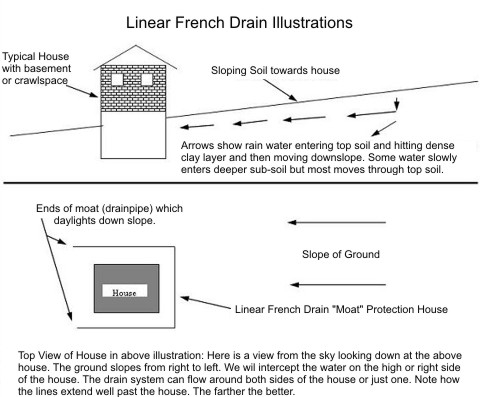
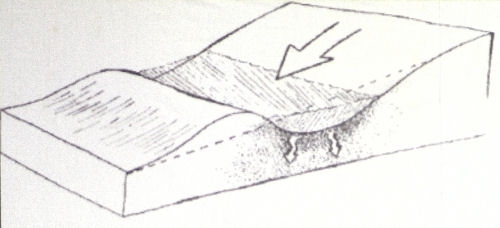
A lot of people here lost power during sandy and would have killed for the simple and functional system you are describing. Gravity hasn't failed yet.

@metaphysician - Excellent illustration

FilmCarp said:

A lot of people here lost power during sandy and would have killed for the simple and functional system you are describing. Gravity hasn't failed yet.

+1

Sump pump. Even if you don't think it's necessary, the person that buys your house someday may think it's necessary.

I have sump pump and french drains inside, and outside (I think it's that moat type of thing above - all were put in before I bought). They all work well together, and that is what works for my house. If you have gravity on your side, start there... don't worry about what the next person who buys your house may want - you just bought, do what works for you. The thing to do is be sure that Gregory (or whoever installs) keeps in mind a place or way to add in a sump pump if that becomes necessary....

I do like their 25-year guarantee that no natural water will seep into the basement, and I am now starting to lean a bit more towards their proposal since it does seem to make logical sense and also addresses the moisture in our garage…
- rj

My house has only french drains, no sump pump, installed when it was built (in the 1980's). We do have a drain in our driveway and the driveway is slightly sloped toward it. Plus the back of our basement and garage are ground level, not underground (front of the basement is underground), not sure if that makes a difference..

We've been here almost 5 years and never had water. Prev owner had her art studio in the basement, would doubt she would do that if there was a water issue.

I'd have to think the cost differential is pretty small. The pumps aren't terribly expensive... and there's pretty limited plumbing installed. We have a very similar situation, and went with a sump. At least one contracted said they wouldn't cut holes in the foundation for the drains below grade.

One point, make sure you make clear that you expect them to clean up. Our drain contractor left one hell of a muddy mess.

sump pump not expensive. French drains are the real expense. We used Gregory, and they put i the 2nd pump because we were on the cusp. Not looking back with regret at all, totally happy with what they did.

I simply cannot imagine a scenario where I wouldn't do both. If the sump pump fails, so what? Drains kick in. Egress on the drains gets clogged up somewhere, pumps are working. As said above, money is in the drain work, not the pumps anyway.

Robjohn: same scenario--on very steep hill by reservation, garage at grade and house built into hill sideways--street is a steep hill. We have french drains and no sump pump--was set up that way when we moved in. Our old Maplewood house had sump pump and drains so we fully expected to add pump but never did it. We've never gotten water at all--not even in Irene. We are crazy about keeping gutters and leads clean, but the drains work and gravity helps immensely.

I might give just drains a try given the geography--but if the cost is minimal and you're fully finished (ours is semi) with carpet and whatnot--think hard. Though gregory does know their stuff and I was told they did my house....


I doubt that they would have suggested it unless they were pretty sure it would work. And, a bonus, no backup needed for power failures!

He is doing French Drains regardless. There is no electrical component to the drains. The sump pump runs on electricity, so should the drains fail and power is lost, there could be water that over runs the drains that can not be handled by a sump pump.

Perhaps the best course of action is to go ahead with only the French Drains. Do not finish basement with flooring and drywall until you have gone through spring and fall rainy season and winter with snow accumulation. If you remain dry through all that, don't worry about sump pumps. If you notice moisture request sump pump install. Moisture will destroy flooring and drywall with mold.

The sump pumps are the least expensive portion of basement moisture control.

I recently had my basement waterproofed and I used Vulcan and I have to say will all these storms we had these past couple of weeks we haven't got a drop of water. What ever you do don't call Midatlantic Waterproofing they are rip offs they quoted me a price of $15,000.00 and when I called Vulcan they charged me $5,000.00 so make sure you get estimates. Both companies were doing the same kind of work but one is much more expensive then the other.

I think people commonly misunderstand what the pump actually does. The collection of water to a pit (sump) is the job of a network of drains. These could be "french drains" around the perimeter or perforated pipe under the slab or around the exterior. Once this water is routed to the sump, the only job of the pump is to overcome gravity to build a head that allows the water to get to discharge point where gravity again takes over. If the property is set up so that there is a sufficient, natural grade that would allow the pit to empty on its own, what exactly would the pumps do?

I think folks have this idea that the pump is somehow sucking underground water from beneath the slab or away from walls (reducing the natural hydrostatic pressure). That's not what it's doing.

ctrzaska said:

I simply cannot imagine a scenario where I wouldn't do both. If the sump pump fails, so what? Drains kick in. Egress on the drains gets clogged up somewhere, pumps are working. As said above, money is in the drain work, not the pumps anyway.


I had both in my house in Maplewood. I think the entire system worked properly exactly once. I had routine flooding, exacerbated somehow after the "waterproofing" of the basement. The sump pump didn't work unless I trudged over and jiggled it; only then would water disappear from the basement. From that (this was a long time ago and I knew something close to nothing) I figured that the sump pump was the primary means by which water would exit. Turns out the French drains were useless. Very expensive mistake.

You can not reply as this discussion is Closed!

Featured Events

Latest Jobs

Employment Wanted

Advertisement